10K
41.7% gold, with the greatest alloy proportion among these four choices.
Gold Education
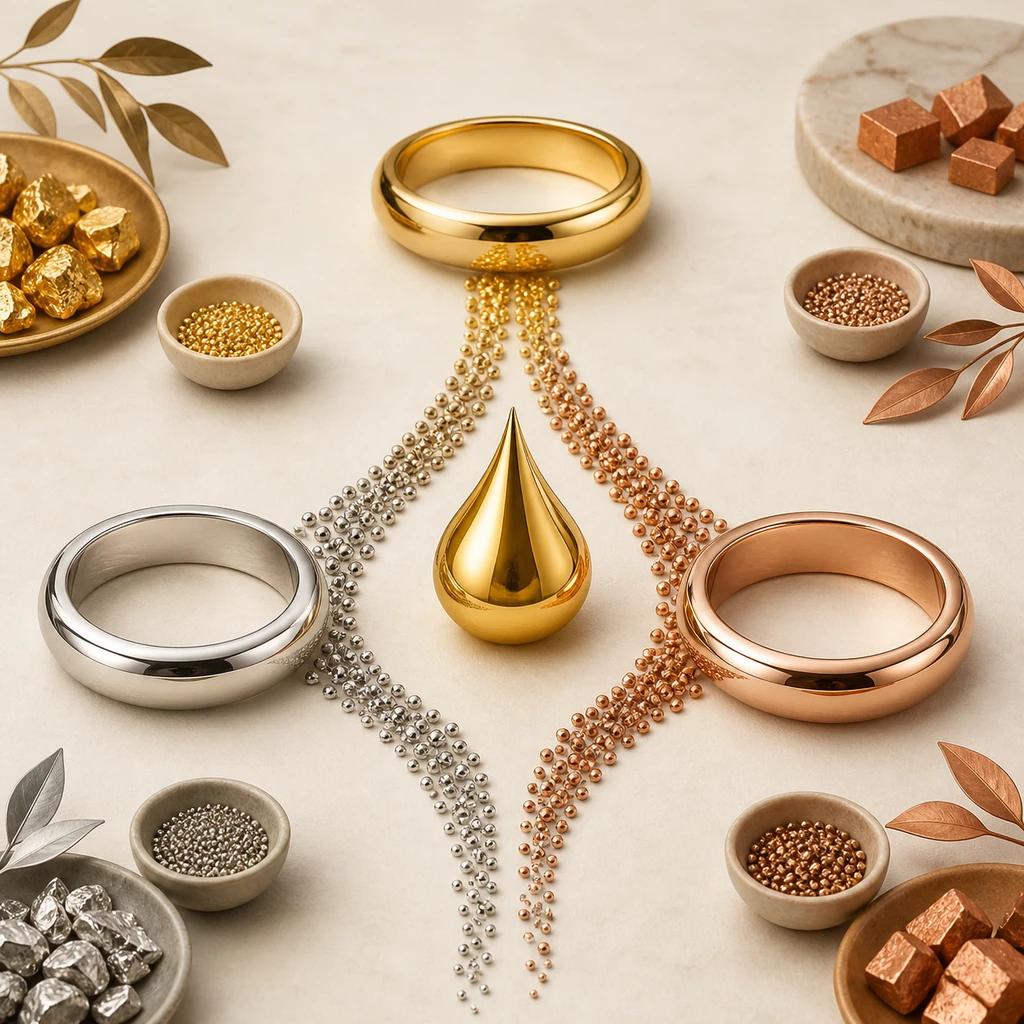
AI-generated educational visual; artistic representation.
The Essential Idea
Pure 24K gold is naturally rich yellow and comparatively soft. For most fine jewelry, gold is combined with other metals to create an alloy with the desired purity, color, strength, and manufacturing performance.
Karat answers how much gold is present. It does not, by itself, tell you the precise alloy recipe, exact color, hardness, construction quality, or whether a surface plating has been applied.
41.7% gold, with the greatest alloy proportion among these four choices.
58.3% gold and a widely used balance of gold content and everyday practicality.
75% and 91.7% gold, offering richer gold content with different wear considerations.
Purity by Parts
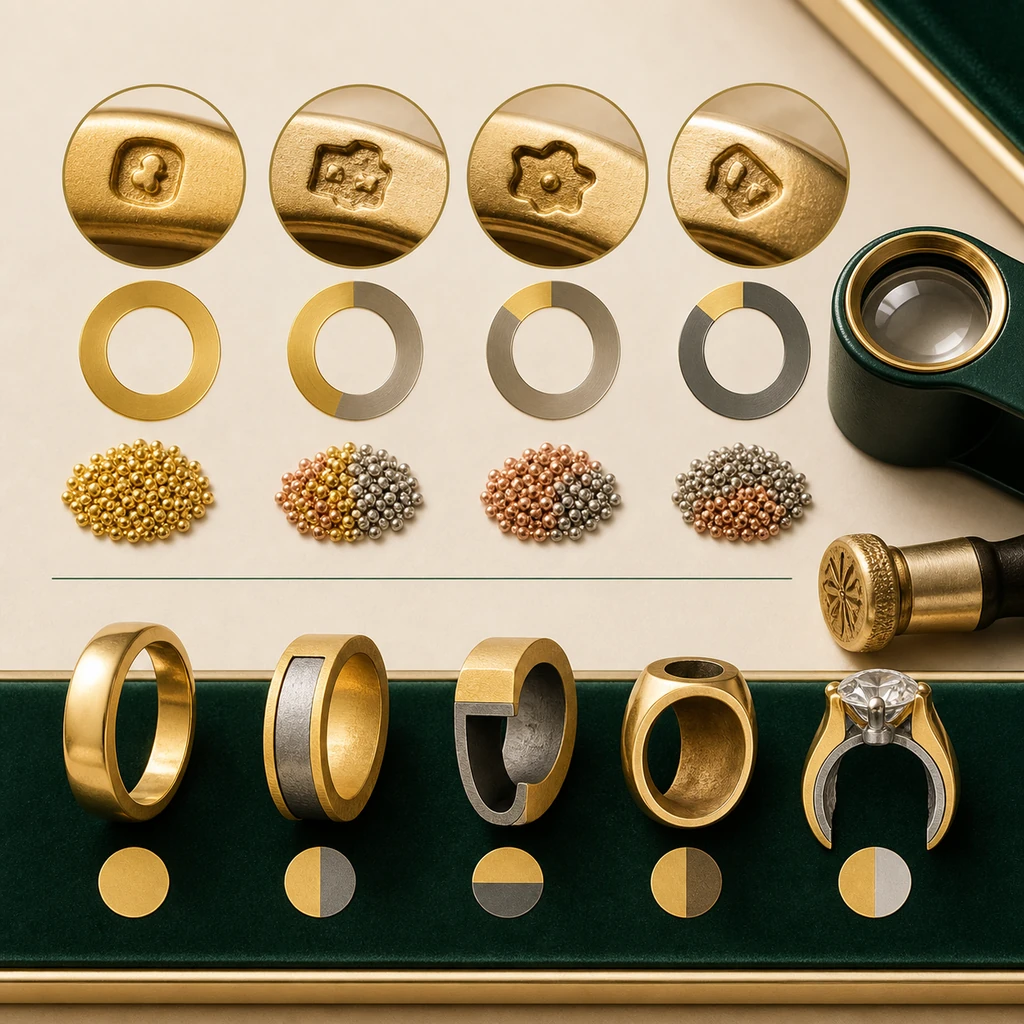
Karat measures gold as parts out of 24. Dividing the karat number by 24 gives the nominal gold percentage: 10K is about 41.7%, 14K about 58.3%, 18K 75%, and 22K about 91.7%.
Higher karat means more gold, not automatically better jewelry. Lower-karat alloys often provide more hardness and a lower material cost; higher-karat alloys offer richer gold color and content but are generally softer. Twenty-four-karat gold is essentially pure gold and is generally too soft for many everyday fine-jewelry structures. Twenty-two-karat gold may be used selectively in protected bezels or mounting elements, but exact performance depends on the alloy recipe, thickness, and design.
Marks & Language
A 10K item may be marked 10K or approximately 417, 14K may appear as 14K, 583, or 585, 18K as 18K or 750, and 22K as 22K or approximately 916 or 917. Manufacturing tolerances and national conventions can affect the mark used.
In the United States, karat fineness should accompany the word gold when the item is not 24K. Also distinguish karat gold from gold plate, gold-filled, hollow construction, and vermeil; these terms describe different structures.
Gold in Color
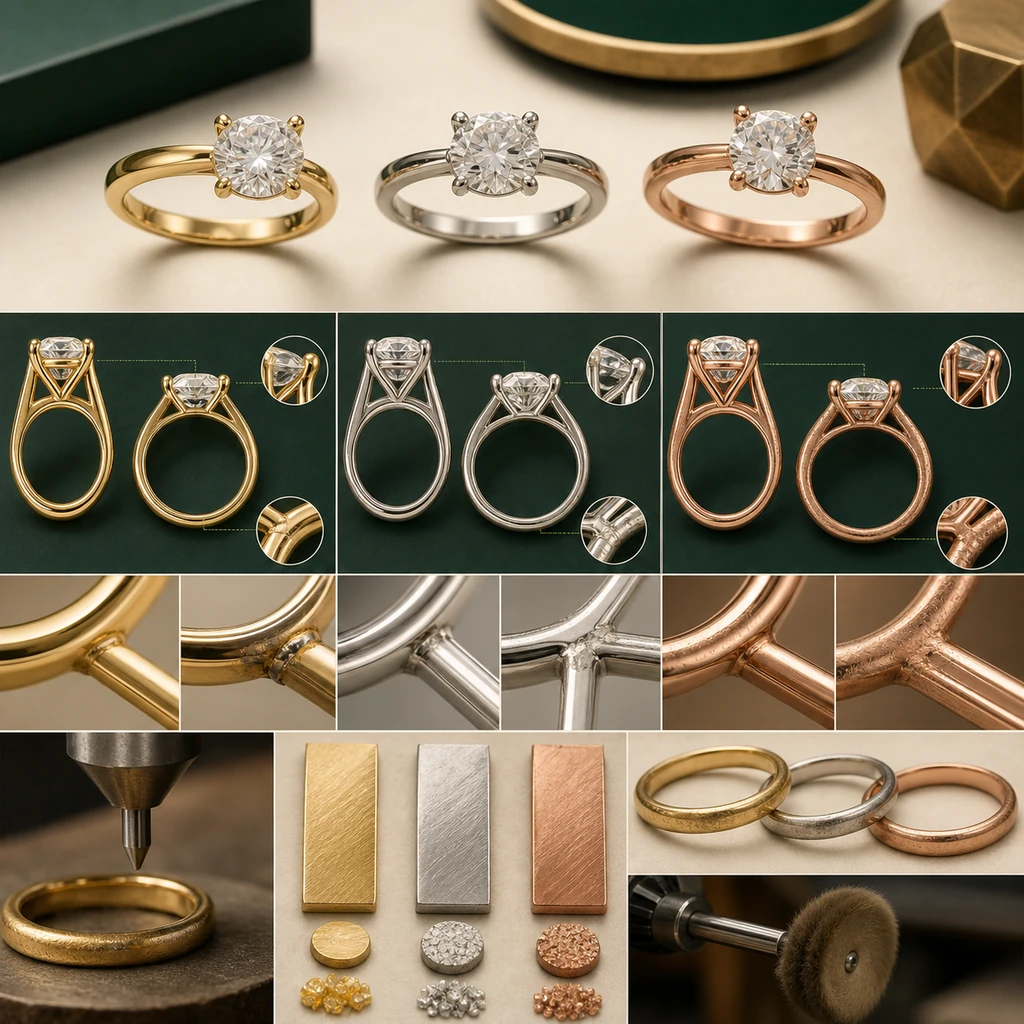
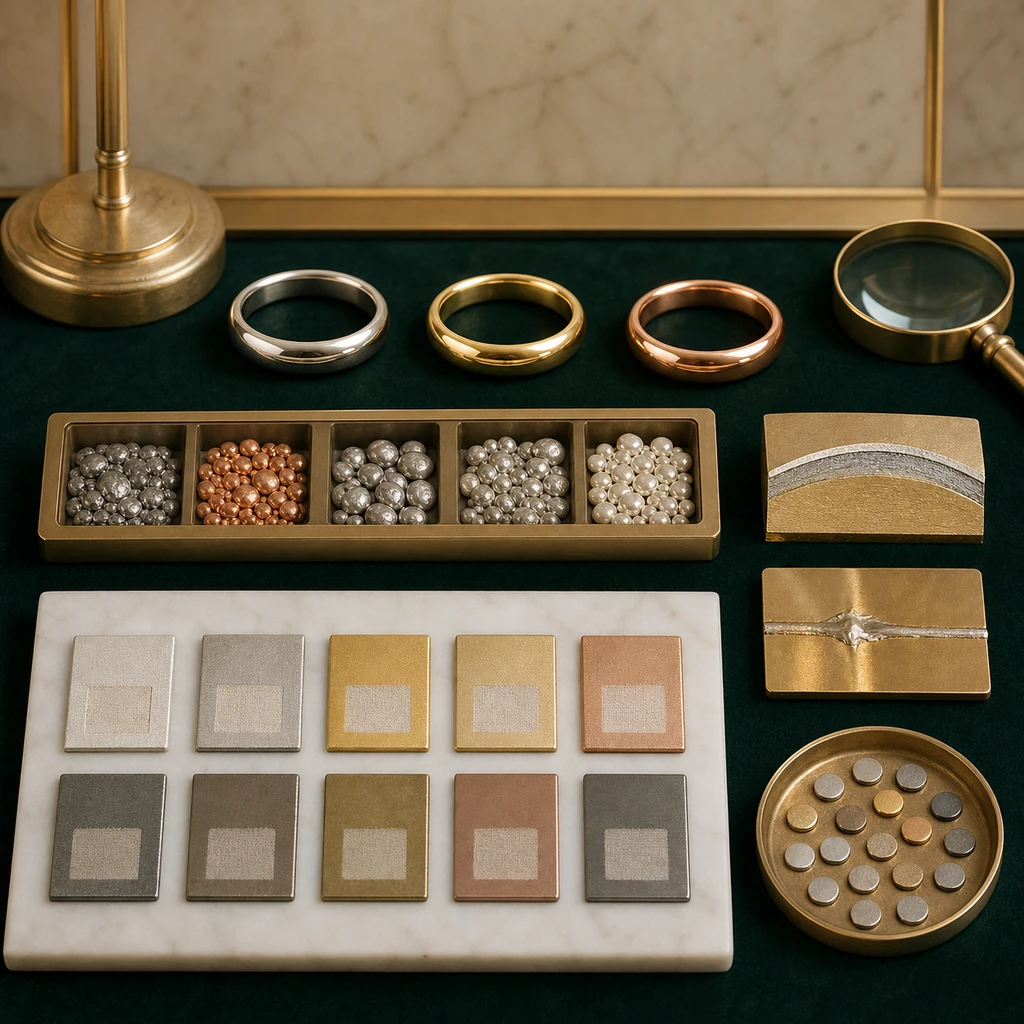
Yellow gold typically combines gold with metals such as silver, copper, and zinc while preserving a warm appearance. White gold uses light-colored alloying metals such as nickel or palladium, often with zinc or other additions, to reduce gold's natural yellow appearance. Rose gold receives its blush color primarily from a greater copper contribution, often balanced with silver.
There is no single universal formula for any color. Two 14K yellow gold alloys—or two 18K rose gold alloys—can differ in hue and hardness. White gold is commonly rhodium plated for a brighter white finish.
Gold + commonly silver, copper, and zinc
Gold + commonly nickel or palladium, often zinc
Gold + a greater contribution of copper
Wear & Construction
As gold content rises, an alloy generally becomes softer and more malleable, but alloy chemistry and heat treatment can change the result. A well-made 18K setting may outperform a poorly designed 14K setting. Thickness, profile, prong geometry, solder joints, and daily habits all matter.
Scratching is normal for precious metal jewelry. Over time, fine scratches create a patina; polishing can restore brightness but removes a very small amount of metal, so it should be performed thoughtfully.
Skin Sensitivities
Gold itself is often well tolerated, but an alloy may contain nickel, copper, or another metal that causes a reaction in a sensitive wearer. Nickel is a common concern in some white gold alloys; copper sensitivity can also occur.
A rhodium layer may temporarily separate skin from the underlying alloy, but plating wears. If you know you are sensitive, ask whether the piece is nickel-free, what the alloy contains, and whether future repair materials may introduce another metal.
Gold Care
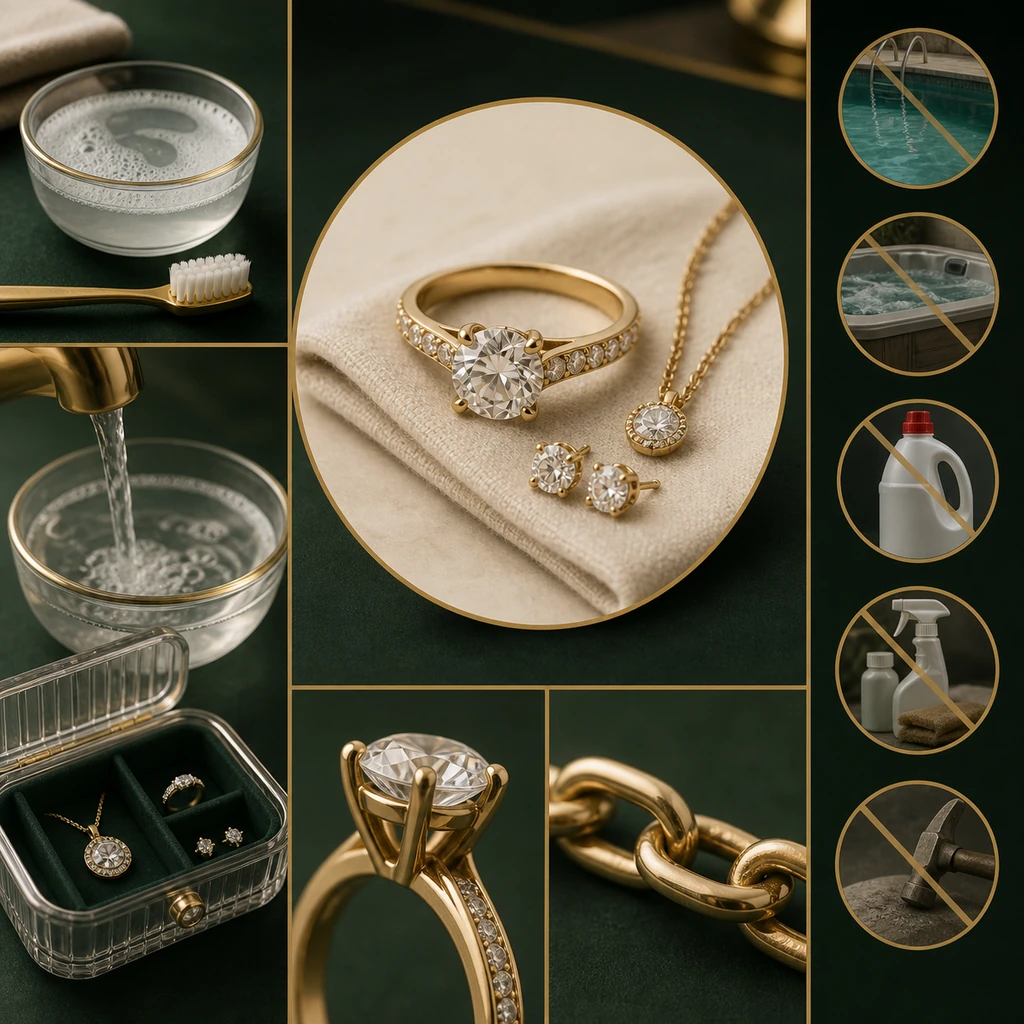
Avoid chlorine, bleach, and harsh chemicals, which can attack certain alloying metals and soldered areas. Remove gold jewelry before pools, hot tubs, household cleaning, and high-impact work.
For suitable diamond-and-gold pieces, use lukewarm water, a small amount of mild dish soap, and a very soft brush, then rinse and dry carefully. Do not use this method automatically for every gemstone or construction. Store pieces separately to reduce scratching and inspect frequently worn jewelry periodically.
From Education to Exploration
Continue From Learning to Exploring
Terminology and facts were reviewed against current guidance from independent gemological and U.S. consumer-protection authorities. Report formats and services can change.