
Color
For white diamonds, color usually describes the relative absence of yellow or brown body color.
White Diamond Education
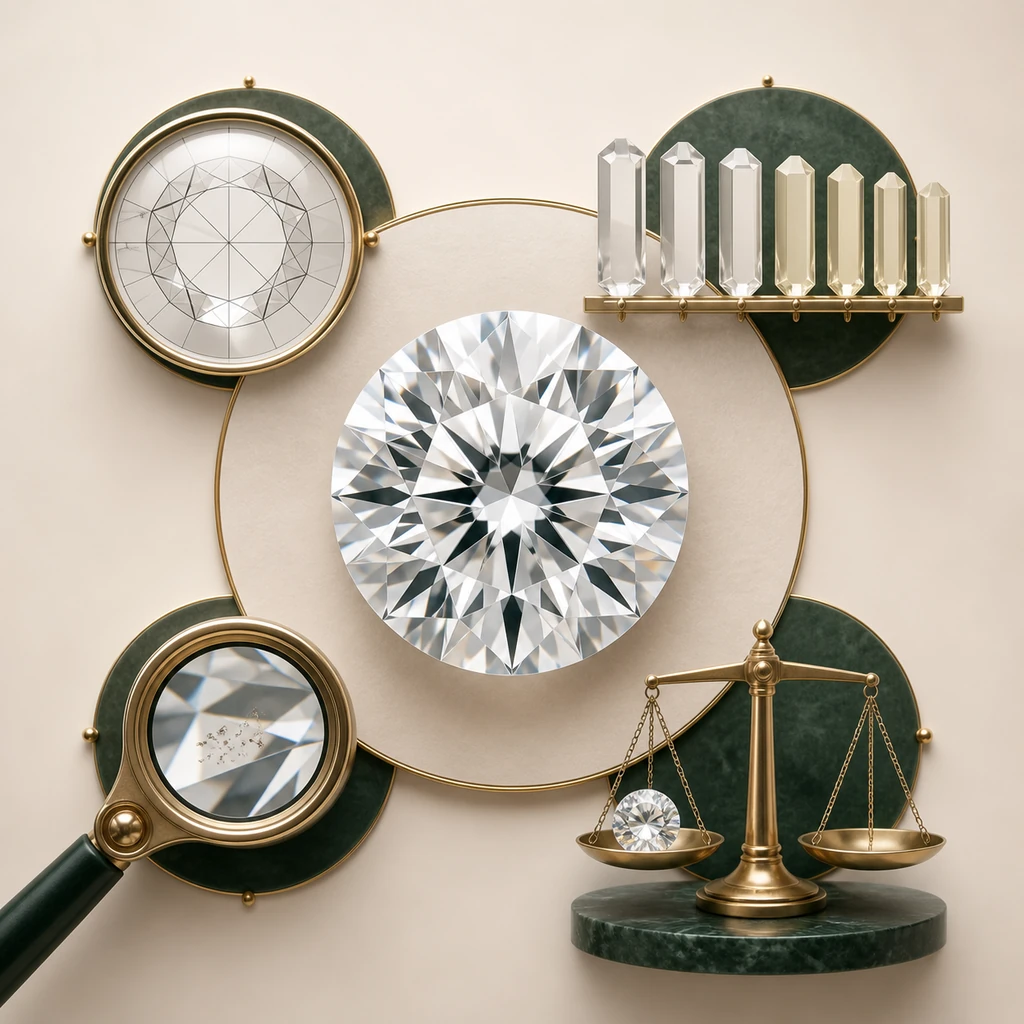
AI-generated educational visual; artistic representation.
The Essential Idea
The 4Cs—color, clarity, cut, and carat weight—provide a shared language for describing diamond quality. The underlying concepts are useful for both natural and laboratory-grown white diamonds because both are diamonds and both can vary in appearance and craftsmanship.
The exact terminology on a laboratory report can differ by origin, laboratory, service, shape, and date. Use the 4Cs to understand the diamond, then read the document that actually accompanies it.
For white diamonds, color usually describes the relative absence of yellow or brown body color.
Clarity considers internal inclusions and surface blemishes under controlled examination.
Cut shapes light performance; carat records weight, not a diamond’s visible size.
The First C
In the traditional GIA system for natural white diamonds, color is evaluated from D to Z. D, E, and F are described as colorless; G through J as near-colorless; and progressively more yellow or brown body color becomes visible farther down the scale.
Unlike fancy-color diamonds, whose characteristic color is evaluated face-up, D-to-Z color grading is performed with the diamond table-down. The grader observes through the pavilion—the lower, belly-like portion of the diamond—under controlled lighting and compares the stone with master-color diamonds.
Color grades are subtle. Shape, size, metal color, setting style, lighting, and neighboring diamonds can influence what you notice. A warmer grade is not automatically unattractive—it may be a beautiful and intentional choice.
The Second C
Clarity grading considers inclusions inside the diamond and blemishes on its surface. Graders evaluate their size, nature, number, position, and relief using controlled conditions and 10× magnification.
The scale moves from Flawless and Internally Flawless through VVS, VS, SI, and Included grades. The practical question for jewelry is not only the grade, but also whether a characteristic is visible without magnification or could affect transparency or durability.
The Third C
Cut quality describes how effectively a diamond’s design and workmanship manage light. Brightness is reflected white light, fire is the display of spectral color, and scintillation is the pattern of light, dark, and sparkle seen as the diamond moves.
GIA’s overall cut grade applies to standard round brilliant diamonds in the D-to-Z range. Fancy shapes require a broader evaluation of proportions, symmetry, polish, outline, durability, and face-up light performance.
White light reflected from the diamond.
White light separated into spectral color.
Sparkle and shifting light-dark pattern.
The Fourth C
One metric carat equals 200 milligrams and is divided into 100 points. A 0.50-carat diamond is often called a fifty-pointer.
Two diamonds with the same carat weight may have different face-up dimensions because shape, proportions, girdle thickness, and depth distribute weight differently. A diamond with a smaller visible diameter may carry more weight below the girdle in a deeper pavilion. Compare millimeter measurements as well as carat weight, while remembering that a wider but excessively shallow diamond can sacrifice attractive light performance.
Natural & Laboratory-Grown
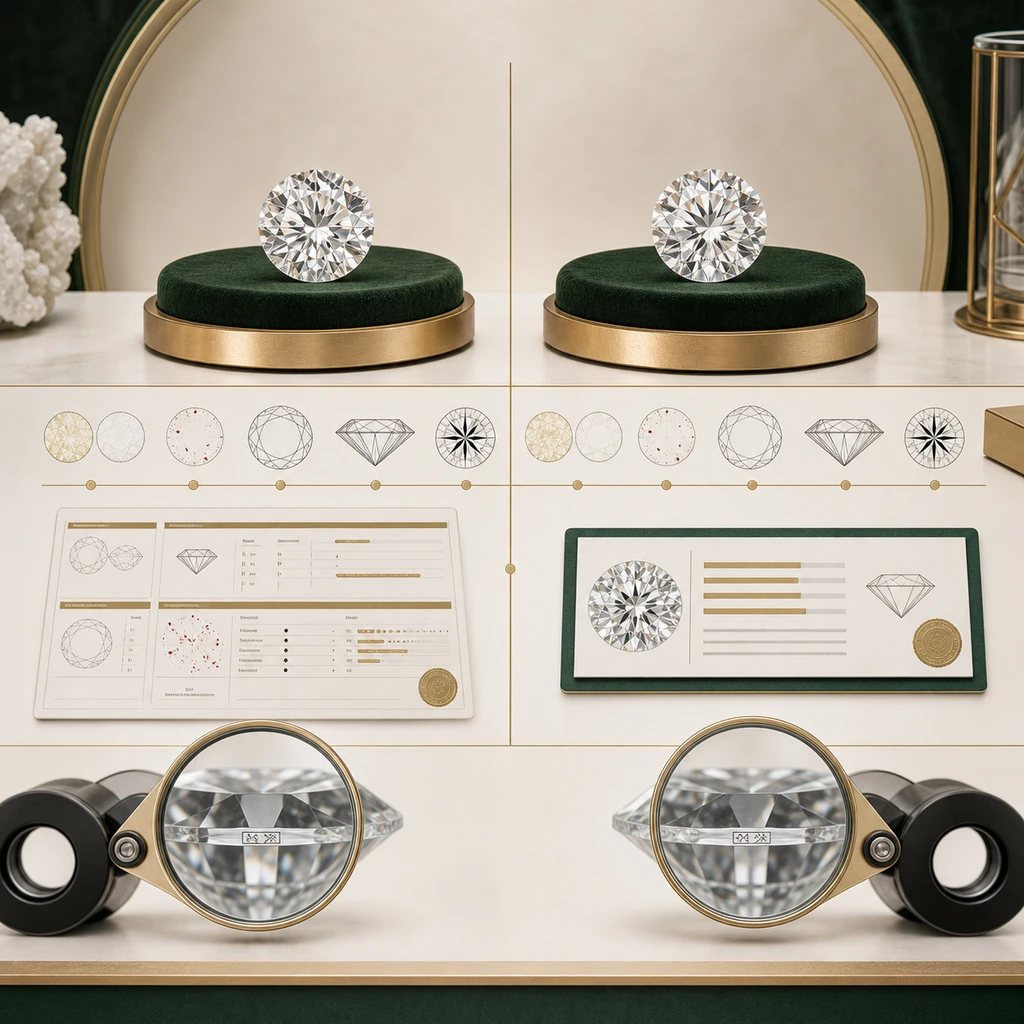
Natural and laboratory-grown white diamonds can both be discussed through color, clarity, cut, and carat weight. This makes the 4Cs useful when comparing appearance, proportions, and craftsmanship across either origin.
However, grading documents are not interchangeable. Since October 1, 2025, GIA has classified qualifying loose D-to-Z laboratory-grown diamonds as Premium or Standard using an overall assessment of color, clarity, polish, symmetry, and—where applicable—cut. Other laboratories and older reports may present traditional letter and clarity grades.
Beyond Four Letters
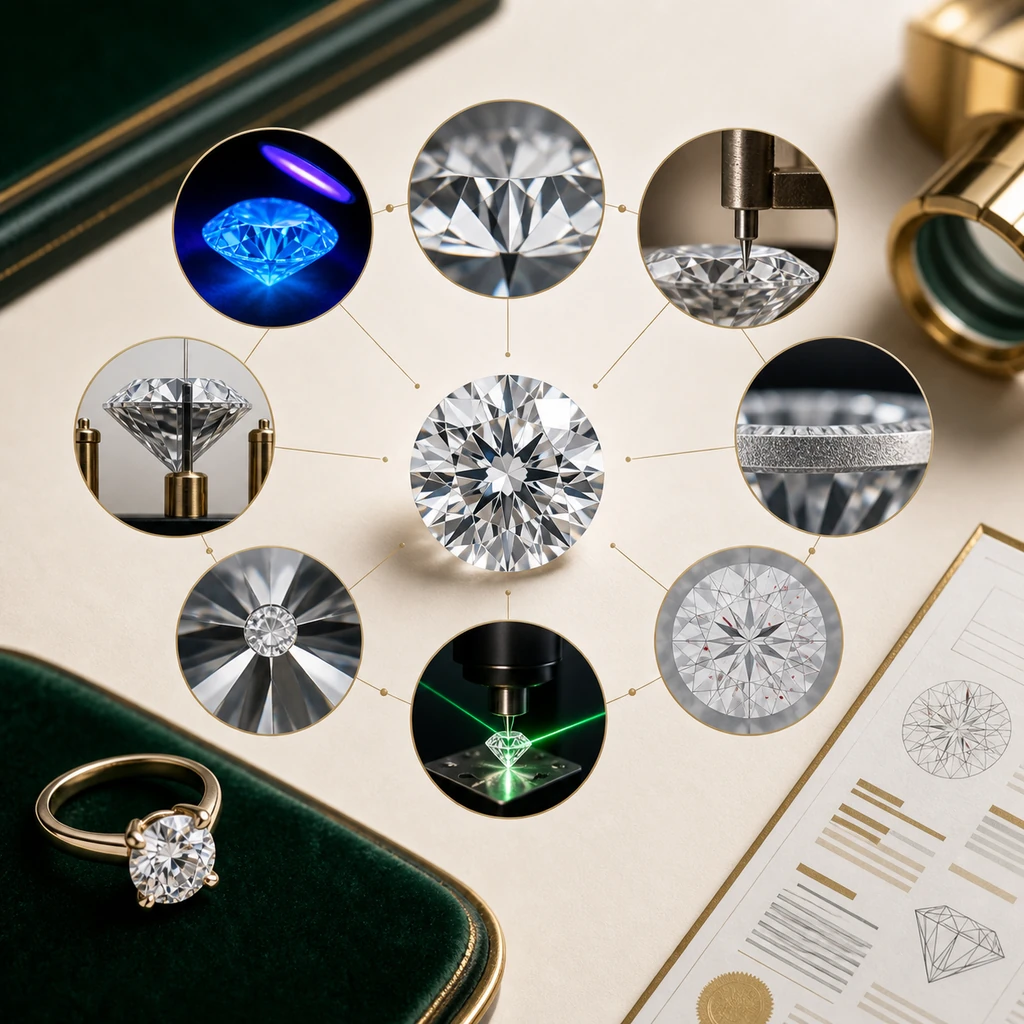
Fluorescence, polish, symmetry, measurements, girdle thickness, culet, treatment disclosure, growth information, and the location of clarity characteristics can all add important context.
Finally, a grading report describes a loose diamond at the time of examination. It is not an appraisal, a price guarantee, or a substitute for evaluating the finished jewelry.
From Education to Exploration
Continue From Learning to Exploring
Terminology and facts were reviewed against current guidance from independent gemological and U.S. consumer-protection authorities. Report formats and services can change.