The eye is not enough
Natural and laboratory-grown diamonds share essentially the same composition and properties.
Diamond Verification
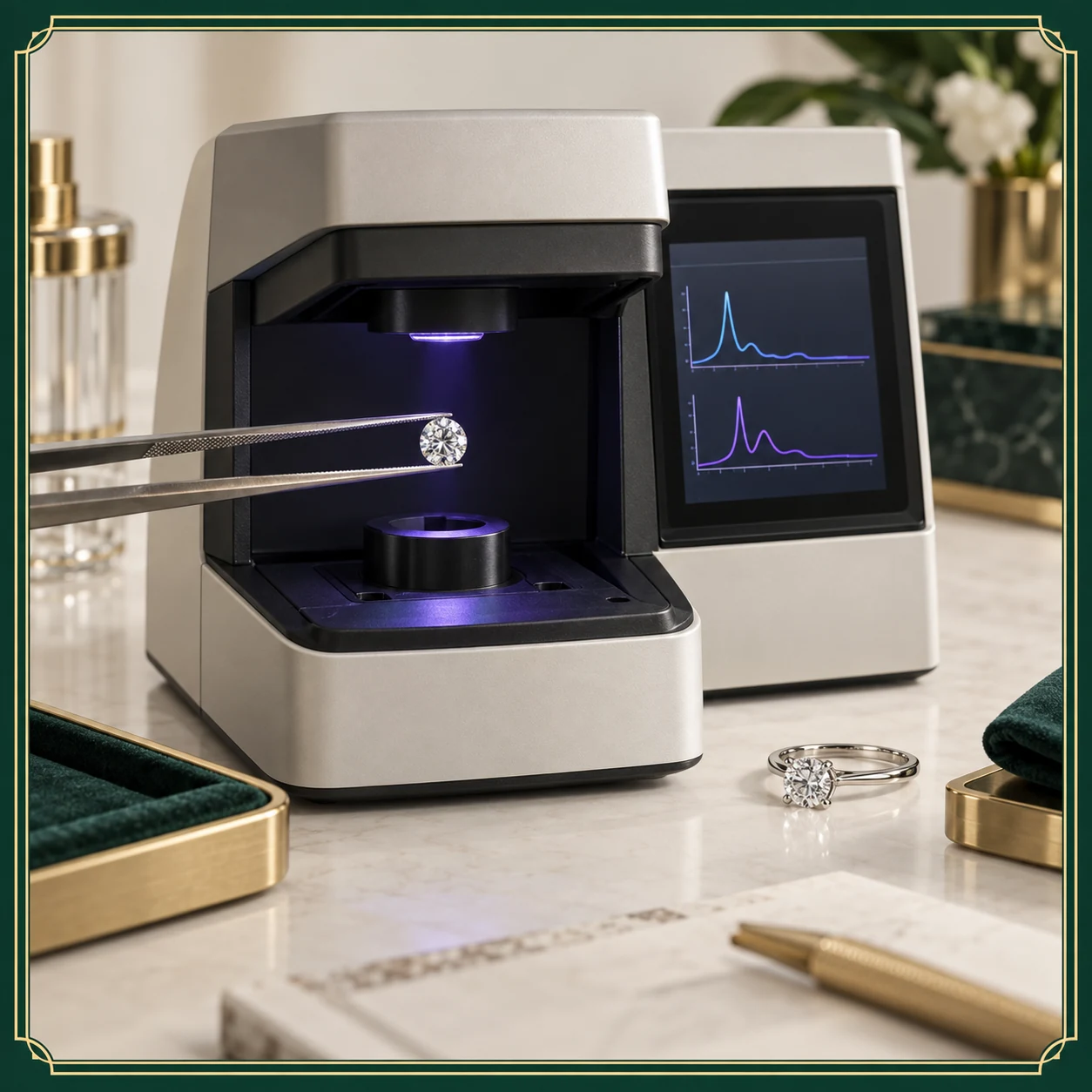
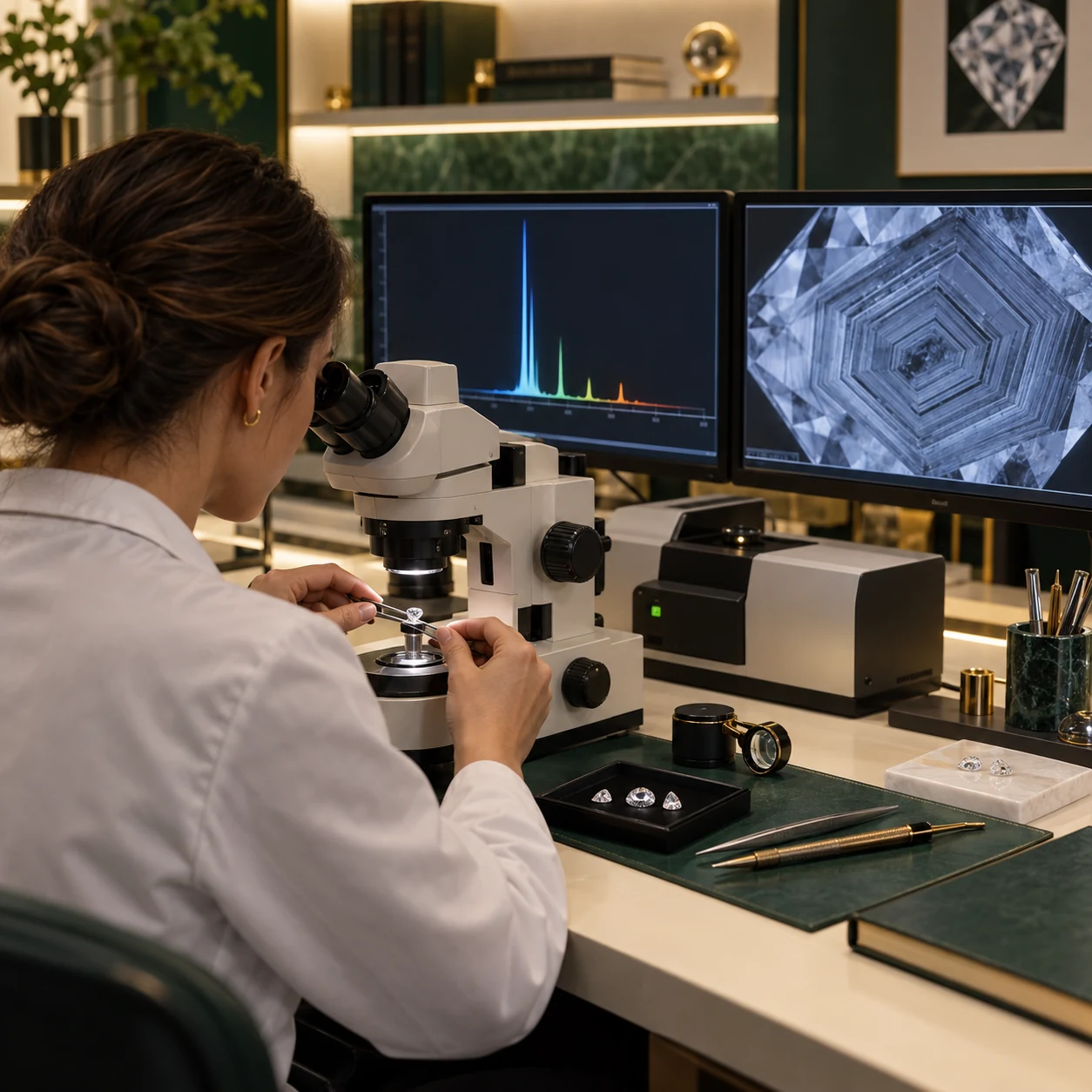
AI-generated educational visual; artistic representation.
The Essential Idea
A laboratory-grown diamond is a real diamond, so it cannot be reliably separated from a natural diamond by appearance alone. The difference is its growth history—and modern instruments are designed to find the tiny optical and structural clues that history leaves behind.
Large gemological laboratories use several advanced tests together. Today, jewelers and suppliers can also use smaller screening devices to check loose diamonds and, with some instruments, stones already set in jewelry. These tools make screening faster, but their results must still be read correctly.
Natural and laboratory-grown diamonds share essentially the same composition and properties.
Instruments measure fluorescence, phosphorescence, spectra, and growth-related defects.
A screening referral is not, by itself, a final laboratory-grown identification.
Start Here
Natural and laboratory-grown diamonds are both crystalline carbon and can share the same hardness, brilliance, and basic thermal behavior. A loupe, microscope, or traditional diamond tester may help identify a simulant such as glass, but it does not reliably establish whether a true diamond grew in the earth or in a laboratory.
A laser inscription on the girdle can be helpful when it matches a grading report, but verification should not depend on an inscription alone. Specialized screening looks inside the diamond for evidence connected to growth, trace impurities, and atomic-scale features.
The Simple Explanation
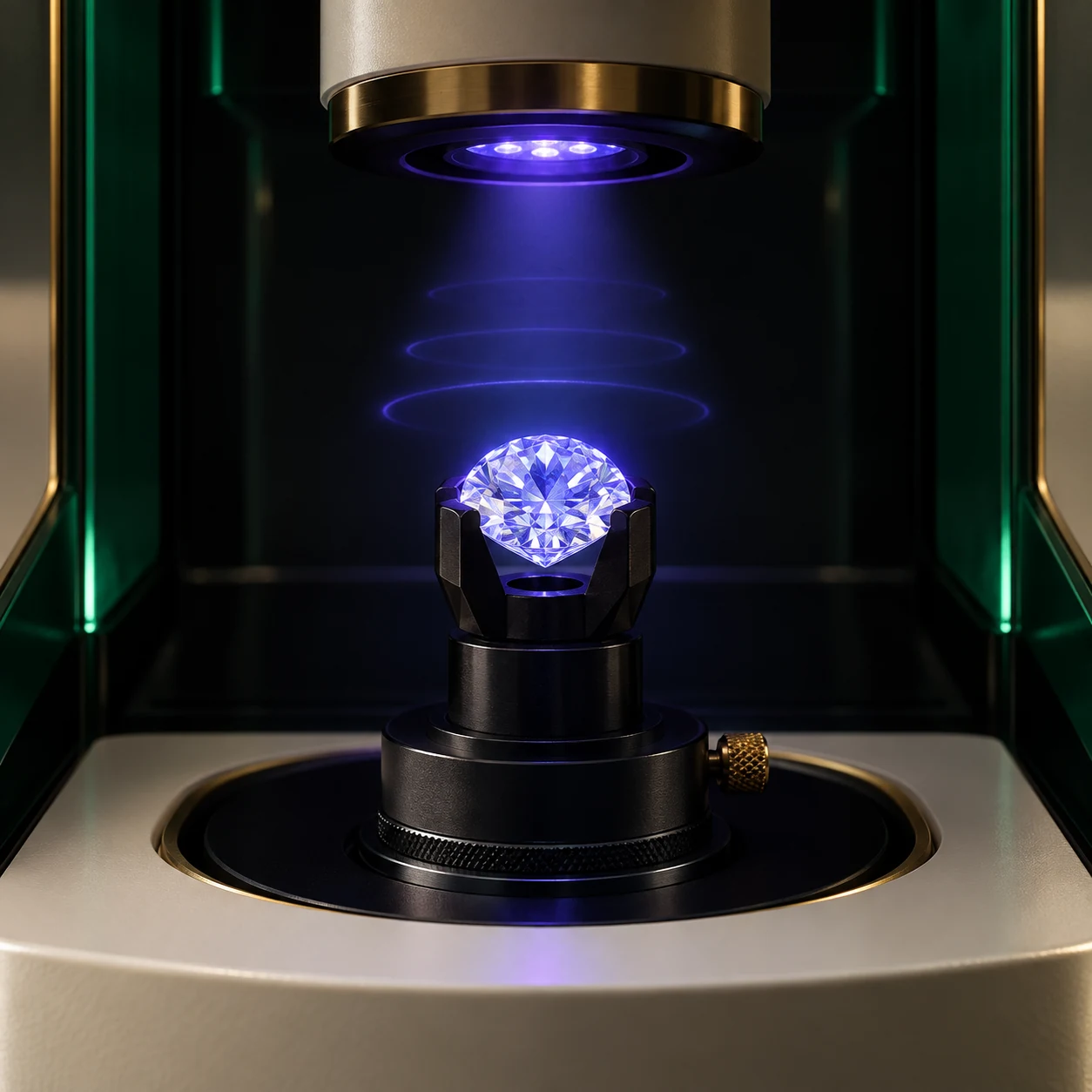
A screening instrument shines carefully controlled light—often ultraviolet light—into the diamond and measures the light that returns. It can examine color or wavelength, intensity, pattern, and timing. Fluorescence is light emitted while the diamond is being excited; phosphorescence is an afterglow that continues after the excitation stops.
These responses come from trace impurities and irregularities in the diamond's crystal lattice, often called defects. Natural growth, HPHT growth, and CVD growth tend to produce different combinations and distributions of these features. The instrument compares the measured signature with known patterns rather than judging the diamond by eye.
No single glow or spectral peak tells the whole story in every diamond. Reliable separation depends on the instrument's tested range and, when necessary, several observations used together.
Modern Screening
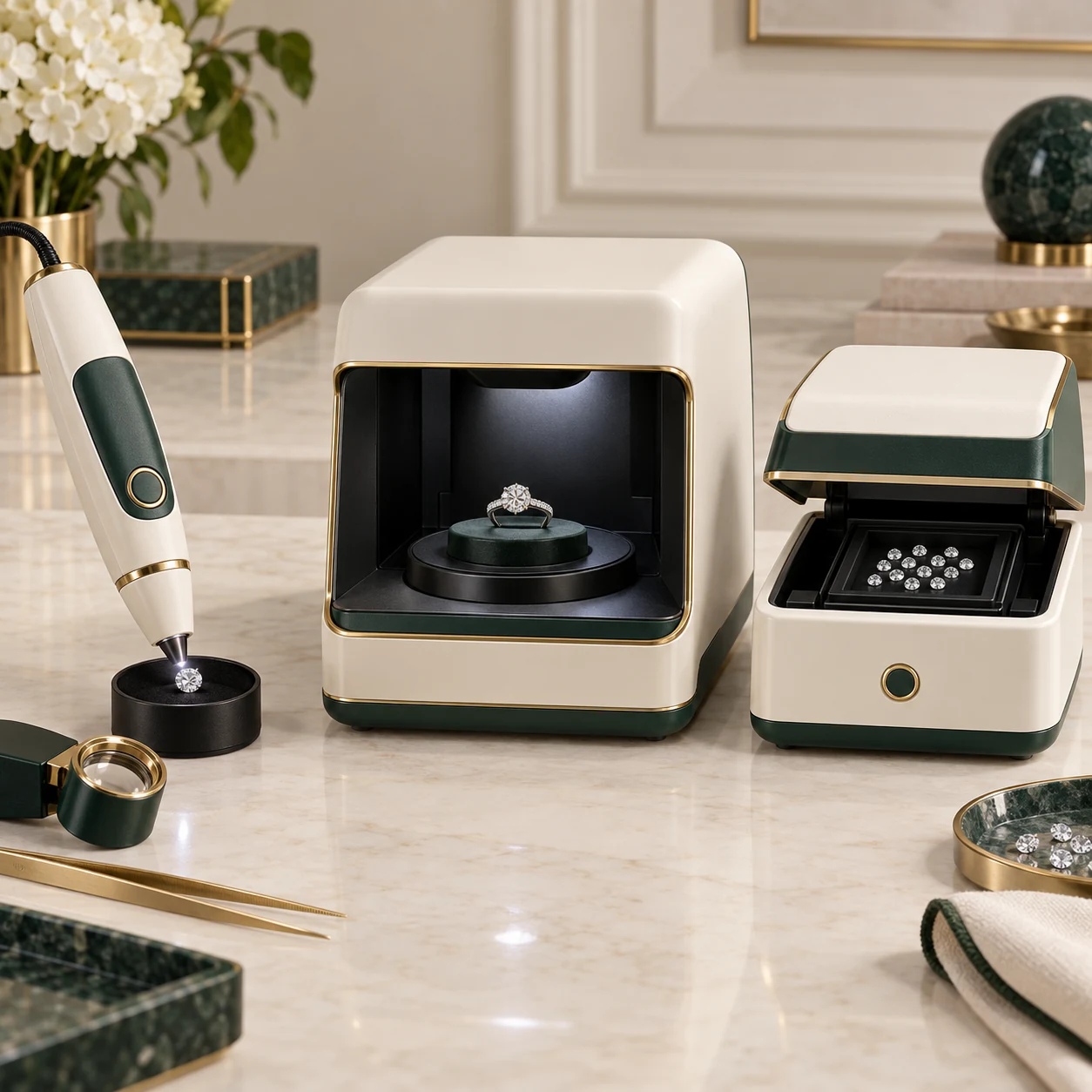
Modern screeners come in several formats. A probe-style instrument can test one loose or mounted stone at a time. An imaging unit can examine an entire ring or another piece of jewelry. Automated systems can move many small loose stones through a screening sequence for parcel control.
For example, GIA describes its compact iD100 as a fluorescence-spectroscopy device that can test loose or mounted diamonds as small as 0.9 mm and provide a result in under two seconds. De Beers' SynthDetect uses time-resolved photoluminescence to image loose stones and diamonds mounted in jewelry. Exact stone sizes, colors, shapes, and mounting types vary by instrument, so the operator must follow that model's stated scope.
These smaller machines help retailers and manufacturers check inventory more efficiently. They are screening tools—not substitutes for a complete grading report or every test available at a gemological laboratory.
Read the Result Correctly
Many screening devices are designed as gatekeepers. A Pass result means the tested stone produced a natural-diamond signature within that instrument's supported range. A Refer result means the stone did not meet the device's pass criteria and requires additional testing.
A referred stone may be laboratory-grown, treated, a simulant, outside the instrument's supported range, or an unusual natural diamond whose response overlaps the referral category. That is why responsible sellers should never translate Refer directly into a final identification.
The safest workflow is simple: screen first, isolate every referred stone, and send those stones for appropriate follow-up testing before making an origin claim.
When More Testing Is Needed
A laboratory can combine microscopy, fluorescence imaging, and several forms of spectroscopy. These methods can reveal growth zoning, strain patterns, trace impurities, atomic defects, and treatment evidence that may not be visible in ordinary lighting.
Depending on the stone, the laboratory may analyze absorption in ultraviolet, visible, near-infrared, or infrared light, and study photoluminescence produced by laser excitation. The combined evidence can establish natural or laboratory-grown origin and may also support a conclusion about HPHT or CVD growth and post-growth treatment.
This layered approach is why a laboratory report remains the strongest independent document for an important diamond, while compact screening is valuable for routine quality control throughout the supply chain.
Buying With Confidence
Look for the words laboratory-grown or lab-grown in the product description, not only in fine print. When a grading report is provided, verify its number through the issuing laboratory and compare the report details with the diamond and any girdle inscription.
Ask whether the seller screens incoming diamonds and how referred stones are handled. A strong quality-control process should separate questionable stones for follow-up testing, preserve supplier documentation, and accurately disclose known origin and treatment information.
Remember that an origin screener does not grade beauty, value, or the 4Cs. Origin verification, quality grading, careful matching, secure setting, and clear disclosure are related—but separate—parts of an informed purchase.
From Education to Exploration
Continue From Learning to Exploring
Terminology and facts were reviewed against current guidance from independent gemological and U.S. consumer-protection authorities. Report formats and services can change.